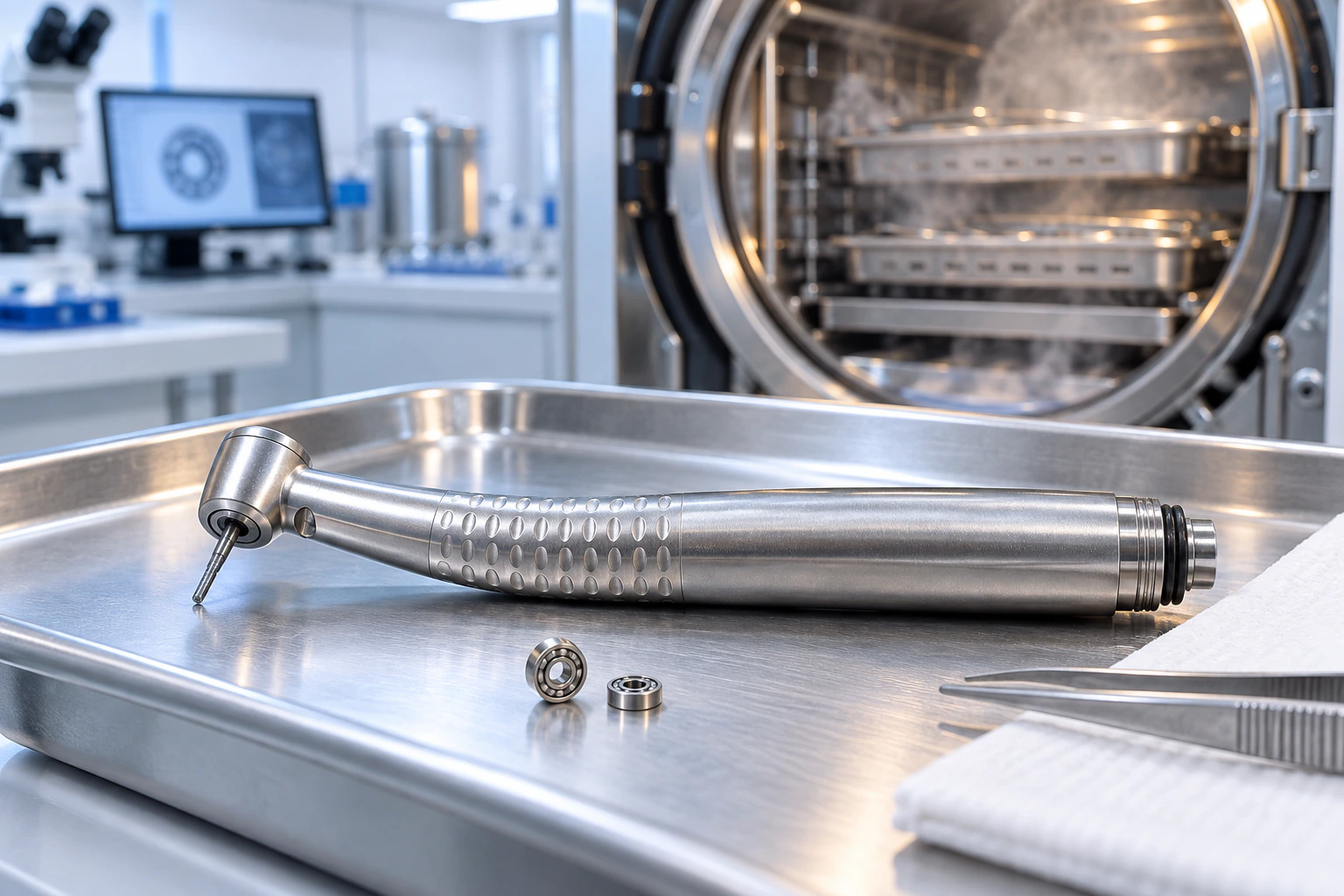
A dental handpiece bearing is not selected by temperature alone. Repeated steam sterilization exposes the bearing assembly to heat, moisture, pressure changes, cleaning residues, drying conditions, storage time, and repeated acceleration back to operating speed. The race material, rolling elements, cage, lubricant, closures, fits, and surrounding handpiece design must work as one system.
The anonymous OEM requirement behind this guide specifies repeated sterilization at 134°C and asks how steel balls, ceramic balls, and cage materials should be chosen. That is a valid project starting point, but it is not evidence that one material combination fits every handpiece. The correct deliverable is a controlled application specification and a repeatable sample-cycle test.
Convert the sterilization process into bearing inputs
Before comparing bearing constructions, document the complete cycle. Record the sterilizer set point, exposure and drying stages, number of cycles expected between maintenance events, cleaning chemistry, rinse method, packaging state, and time between sterilization and reuse. Also record the handpiece speed, radial and axial loading, air supply, internal temperature during operation, and how the bearing is mounted.
NSK's application article on miniature precision bearings for dental drills describes a demanding combination of very high speed, quiet operation, hygiene, cleaning, sterilization, corrosion resistance, and specialized materials. It is useful evidence that these requirements interact. It does not establish the correct SR133 construction or an acceptance limit for a particular LUMI project.
The OEM specification should therefore separate three questions:
- Can the bearing materials tolerate the defined sterilization and cleaning exposure?
- Can the lubricant and cage remain functional across repeated exposure and high-speed operation?
- Can the complete handpiece meet its noise, vibration, temperature, torque, and service-life requirements after the planned cycles?
Compare race and rolling-element materials by failure mode
Stainless race material is not a complete corrosion guarantee
Stainless bearing steel may improve corrosion resistance compared with conventional bearing steel, but the result depends on the exact grade, heat treatment, surface condition, cleaning residues, crevices, and drying. Ask the supplier to identify the proposed material and relevant controlled characteristics. Avoid a purchasing specification that says only “stainless bearing,” because that label does not define the full construction or its validation history.
Inspection should consider raceway condition, external staining, closure condition, and any change in running behavior. If corrosion is a critical failure mode, the responsible engineer must define how it will be evaluated and what constitutes rejection.
Ceramic balls change some risks, not all risks
Ceramic rolling elements can be part of a high-speed dental bearing construction, as noted in the NSK material. Their presence does not make the assembly immune to lubricant degradation, cage damage, race corrosion, contamination, incorrect fits, or steam pathways. The OEM should compare complete bearing variants rather than treating “ceramic” as a stand-alone performance grade.
For a controlled comparison, hold race material, cage, lubricant, internal geometry, clearance or preload target, and manufacturing route constant wherever possible. If several variables change at once, the test may identify a preferred sample but will not explain why it performed differently.
Treat the cage and lubricant as sterilization-critical components
Cage selection must cover heat, moisture, speed, and chemistry
The NSK article discusses engineering-polymer cage options such as PEEK or Torlon in dental applications. That confirms that cage material is an intentional application choice. It does not mean every grade of those polymers is interchangeable or suitable for the customer's exact sterilization process.
Request the controlled cage material, molding or machining route where relevant, temperature exposure assumptions, and any known chemical restrictions. During validation, look for cracking, deformation, discoloration, deposits, abnormal torque, and changes in noise or vibration. Any teardown method and acceptance rule should be agreed before samples are tested.
Lubricant life may become the limiting question
A lubricant must support high-speed bearing operation and survive repeated sterilization without unacceptable loss, migration, oxidation, contamination, or torque change. Do not approve a grease solely because its published temperature range includes 134°C. A short exposure limit, continuous-use rating, base oil behavior, thickener system, sterilization compatibility, and the actual fill quantity can produce different results.
Ask for the proposed lubricant designation or an agreed controlled performance specification, fill range, application method, and change-control commitment. If the exact formulation is proprietary, procurement still needs sufficient controlled information to prevent an unreviewed substitution.
Build a production-intent sample-cycle test
Establish the baseline before sterilization
Assign traceable IDs to every bearing and handpiece assembly. Record the bearing lot, drawing revision, assembly components, fits, installation tool, operator, and date. Measure the agreed baseline characteristics before the first sterilization cycle. Depending on the product, these may include starting torque, running current or air consumption, speed, temperature, noise, vibration, and visual condition.
Use production-intent shafts, housings, spacers, and assembly methods. A damaged raceway, excessive fit, or assembly load transmitted through the rolling elements can be mistaken for a sterilization failure.
Run defined groups of sterilization and operating cycles
The test plan should alternate sterilization exposure with the actual operating sequence expected in service. Record sterilizer identification, cycle record, cleaning process, drying result, storage interval, and any deviation. At predefined checkpoints, repeat the same functional measurements under the same supply, load, sensor position, and ambient conditions.
Do not invent a universal number of cycles or a generic temperature, torque, or vibration limit. The device engineer must connect sample size, cycle count, checkpoints, and acceptance limits to the handpiece risk analysis and intended maintenance policy.
Inspect trends, not only final pass or fail
A sample may still run at the final checkpoint while showing a deteriorating torque, temperature, noise, or vibration trend. Preserve the time history and compare complete variants. Record leakage, deposits, corrosion, closure movement, and any teardown findings using consistent photographs and inspection criteria.
Supplier evidence procurement should request
Before approval, engineering and purchasing should agree on the minimum evidence package:
- controlled bearing drawing and revision;
- race, rolling-element, cage, closure, and lubricant identification at an agreed disclosure level;
- internal clearance or preload approach and applicable speed assumptions;
- inspection and functional-test records linked to the supplied lot;
- sample and production lot traceability;
- packaging and storage controls;
- notification requirements for material, lubricant, process, tooling, or sub-supplier changes.
A public Reddit discussion about replacement dental handpiece bearings describes a user looking for a suitable replacement and a reply reporting poor durability from a low-cost marketplace bearing. This is practitioner context, not a controlled comparison. It supports the need to validate an application-specific construction instead of approving a bearing by marketplace description or appearance.
FAQ
Is 134°C enough information to choose the bearing?
No. The complete sterilization cycle, cleaning chemistry, drying, cycle count, operating speed, load, fits, lubrication, noise requirement, and maintenance plan are also needed.
Are ceramic balls automatically better for sterilization?
No. Ceramic rolling elements may address selected performance considerations, but the races, cage, lubricant, closures, fits, and surrounding design still control important failure modes.
Can a grease be approved from its temperature range?
No. The OEM must review the type and duration of exposure, sterilization compatibility, fill, migration, torque, high-speed behavior, and performance after repeated cycles.
What should be compared during sample testing?
Compare production-intent constructions using controlled assembly and cycle conditions. Track torque or current, speed, temperature, noise, vibration, visual condition, corrosion indicators, lubricant leakage, and agreed teardown observations.
What must remain under change control after approval?
At minimum, control the drawing, materials, lubricant or agreed performance specification, fill range, internal geometry, clearance or preload approach, key processes, traceability, inspection method, and change notification.
Evidence record and engineering limits
- NSK Europe — Miniature precision bearings for dental drills supports the interaction of high speed, hygiene, cleaning, sterilization, corrosion, stainless steel, ceramic rolling elements, and engineered cages in dental applications. It does not validate a LUMI SR133 construction.
- Reddit r/dentistryph — Dental Handpiece provides public user context about replacement-bearing sourcing and reported durability concerns. It is not a technical standard or controlled test.
Prepare the application boundary for LUMI
LUMI can review miniature bearing options only against the actual project boundary. Send the handpiece speed, radial and axial load, sterilization and cleaning cycle, expected cycle count, drying and storage conditions, fits, sealing arrangement, noise and vibration requirements, lubricant constraints, and planned validation method. See the miniature bearing range, medical-device application context, and quality process, then use the project inquiry form to provide the controlled test conditions.