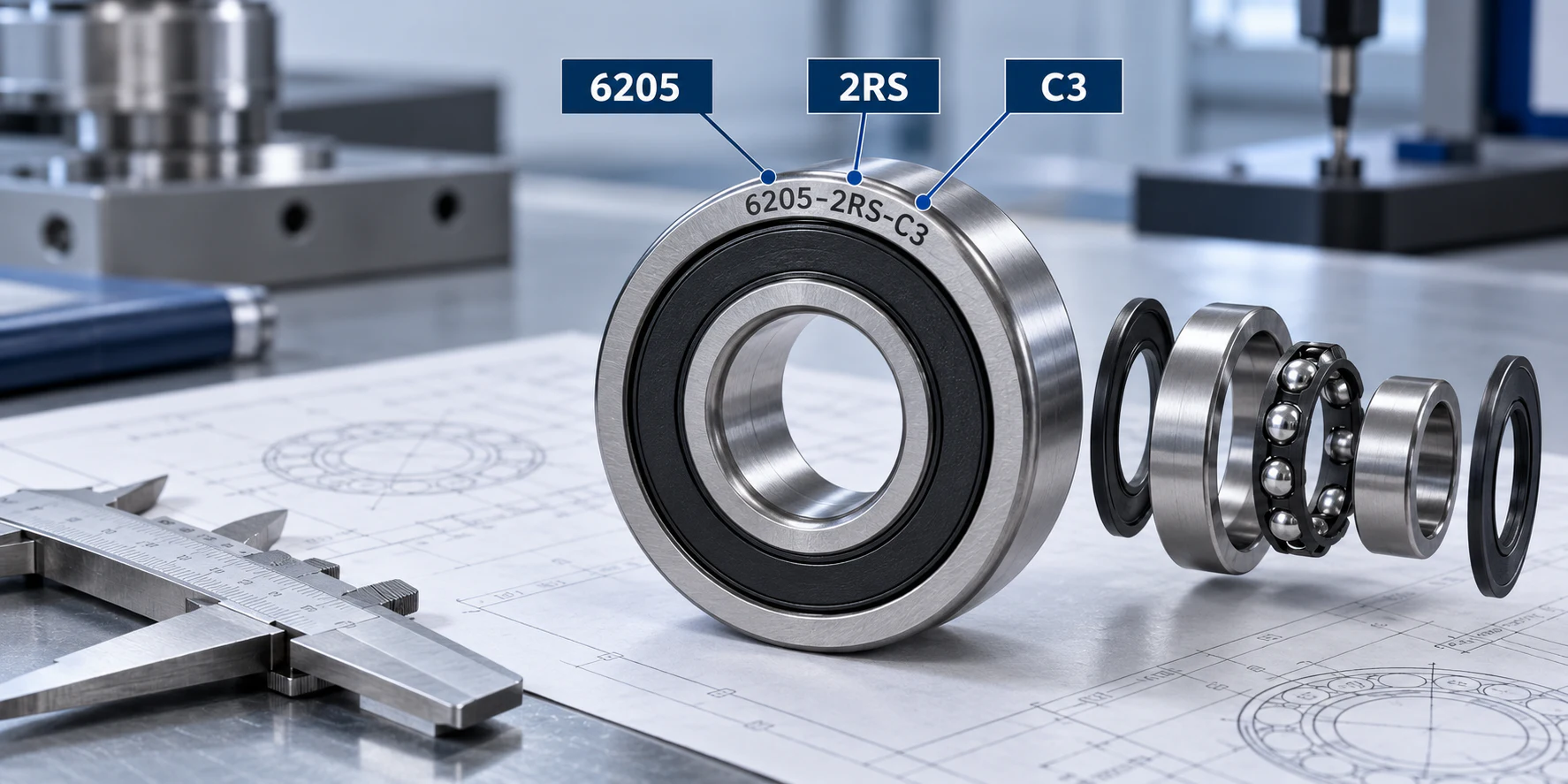
A bearing designation such as 6205-2RS-C3 may look like a short inventory code. In practice, it contains several pieces of technical information: the bearing family, dimensional series, bore code, sealing arrangement and internal clearance.
Understanding those elements helps engineers and buyers identify replacement bearings, compare quotations and avoid ordering a product that fits the shaft but behaves differently in the application.
However, bearing designations must be handled carefully. The basic number often follows widely recognized conventions, while some prefixes and suffixes are manufacturer-specific. Two suppliers may use different suffixes for similar features—or the same-looking suffix may not describe an identical seal, grease or internal design.
This guide explains how to decode common deep groove ball bearing numbers and what information you still need before approving a bearing.
What Does a Bearing Number Tell You?
A complete bearing designation can contain three main sections:
Prefix + basic designation + suffixes
For example:
W 6205-2RS-C3
- W may indicate a particular material or product design.
- 6205 is the basic bearing designation.
- 2RS describes a sealing arrangement.
- C3 describes an internal-clearance class.
The exact formatting varies among manufacturers. Spaces, hyphens and slashes may be used differently, so always retain the complete designation when requesting a quotation.
The basic designation usually identifies:
- The bearing type
- The dimensional series
- The bore size
Suffixes can add information about:
- Shields or seals
- Internal clearance
- Precision
- Cage design
- Lubricant
- Heat stabilization
- Snap-ring grooves
- Matched sets
- Special internal designs
The important purchasing lesson is simple: do not remove suffixes when copying a bearing number into an RFQ.
How to Decode a Common Deep Groove Ball Bearing Number
Consider the designation:
6205
For a common metric deep groove ball bearing, it can be separated as follows:
| Code section | Meaning |
|---|---|
| 6 | Single-row deep groove ball bearing |
| 2 | Dimensional series |
| 05 | Bore code |
The first digit identifies the broad bearing type. In this example, 6 represents a single-row deep groove ball bearing.
The following series information distinguishes bearings with different combinations of outside diameter and width. A 6005, 6205 and 6305 can all have the same nominal bore but different outside dimensions and load-carrying characteristics.
The final two digits are normally the bore code.
How the Bearing Bore Code Works
For many metric bearings with bore codes from 04 upward, multiply the final two digits by five to obtain the nominal bore diameter in millimetres.
Examples:
| Bearing number | Bore code | Calculation | Nominal bore |
|---|---|---|---|
| 6204 | 04 | 4 × 5 | 20 mm |
| 6205 | 05 | 5 × 5 | 25 mm |
| 6206 | 06 | 6 × 5 | 30 mm |
| 6210 | 10 | 10 × 5 | 50 mm |
There are four important exceptions:
| Bore code | Nominal bore |
|---|---|
| 00 | 10 mm |
| 01 | 12 mm |
| 02 | 15 mm |
| 03 | 17 mm |
This means a 6001 bearing has a 12 mm bore—not a 5 mm bore.
The multiply-by-five rule should not be applied blindly to miniature-bearing designations. Common miniature bearings such as 608, 625 and 626 use different numbering patterns:
- 608: commonly 8 mm bore
- 625: commonly 5 mm bore
- 626: commonly 6 mm bore
When working with miniature or special bearings, confirm all three principal dimensions—bore, outside diameter and width—against the manufacturer’s drawing or catalogue.
What Is the Difference Between 6000, 6200 and 6300 Series Bearings?
The 6000, 6200 and 6300 series are commonly used families of metric deep groove ball bearings.
For the same bore code, these series generally represent different dimensional envelopes.
| Series | General description | Typical consideration |
|---|---|---|
| 6000 | Relatively light and compact | Limited installation space and lighter duty |
| 6200 | Widely used general-purpose series | Balance of size, capacity and availability |
| 6300 | Larger outside diameter and width | Higher capacity where more space is available |
For example, 6005, 6205 and 6305 all use the 05 bore code and therefore commonly have a 25 mm bore. Their outside diameters, widths and load ratings are different.
A larger series is not automatically the correct choice. Bearing selection must consider:
- Available shaft and housing space
- Radial and axial loads
- Rotational speed
- Required life
- Shaft and housing stiffness
- Lubrication
- Temperature
- Noise and vibration requirements
For additional product information, see LUMI Bearing’s standard deep groove ball bearings.
What Do ZZ, 2Z, 2RS and 2RZ Mean?
These suffixes usually describe the bearing closures, but exact terminology and seal geometry can vary by manufacturer.
Z or ZZ
A Z suffix commonly indicates a metal shield on one side.
ZZ commonly indicates metal shields on both sides. Some manufacturers use 2Z instead of ZZ.
Metal shields normally create less friction than contact seals, but they do not provide the same exclusion capability as a contacting rubber seal. Their suitability depends on the speed, contamination, lubricant-retention and environmental requirements of the application.
RS or 2RS
An RS suffix commonly indicates a rubber or elastomer seal on one side.
2RS commonly indicates seals on both sides.
However, “2RS” alone does not confirm:
- Seal material
- Contact or non-contact geometry
- Lip design
- Permissible speed
- Operating temperature
- Chemical compatibility
- Friction level
Manufacturers may use suffixes such as 2RS1, 2RSH, 2RSR or 2RS2 to identify their own seal designs.
RZ or 2RZ
RZ often refers to a low-friction or non-contact sealing design. Its precise meaning should be confirmed using the relevant manufacturer’s catalogue.
The practical rule is:
Treat the suffix as a reference to a manufacturer-defined design—not as a complete engineering specification.
For a more detailed closure comparison, see ZZ vs 2RS bearings.
What Does C3 Mean on a Bearing?
C3 refers to a radial internal-clearance class that is greater than normal clearance.
It does not mean:
- Higher dimensional precision
- Better material quality
- A looser shaft fit
- A universal upgrade for motors
- More manufacturing tolerance
Internal clearance is the movement available between the bearing rings and rolling elements before installation. The effective clearance changes after the bearing is mounted and reaches operating temperature.
An interference fit can expand the inner ring or compress the outer ring, reducing clearance. Temperature differences between the shaft, inner ring, outer ring and housing can change it further.
C3 may be appropriate when operating conditions are expected to reduce internal clearance, but it can be unsuitable if the application does not require the additional initial clearance.
Before selecting CN or C3, define:
- Shaft tolerance
- Housing tolerance
- Which ring rotates relative to the load
- Shaft and housing materials
- Interference at each seat
- Operating temperature
- Speed
- Load
- Noise and vibration limits
Clearance selection should follow the complete bearing arrangement, not a preference for one suffix.
Worked Example: What Does 6205-2RS-C3 Mean?
A typical interpretation is:
| Code | Typical meaning |
|---|---|
| 6 | Single-row deep groove ball bearing |
| 2 | Dimensional series |
| 05 | 25 mm nominal bore |
| 2RS | Elastomer seals on both sides |
| C3 | Radial internal clearance greater than normal |
This interpretation is useful for initial identification, but it is not enough for final approval.
The buyer should still confirm:
- Outside diameter and width
- Seal design and material
- Bearing steel or stainless-steel grade
- Cage material
- Lubricant type and fill
- Precision class
- Noise or vibration requirements
- Speed and temperature limits
- Manufacturer-specific suffix definitions
Worked Example: What Does 6204-ZZ Mean?
A common interpretation is:
- 6: deep groove ball bearing
- 2: dimensional series
- 04: 20 mm bore
- ZZ: metal shields on both sides
One manufacturer may label an equivalent-looking closure as 6204-2Z. Even when the main dimensions match, confirm the shield design, internal clearance, grease and performance data before treating two products as interchangeable.
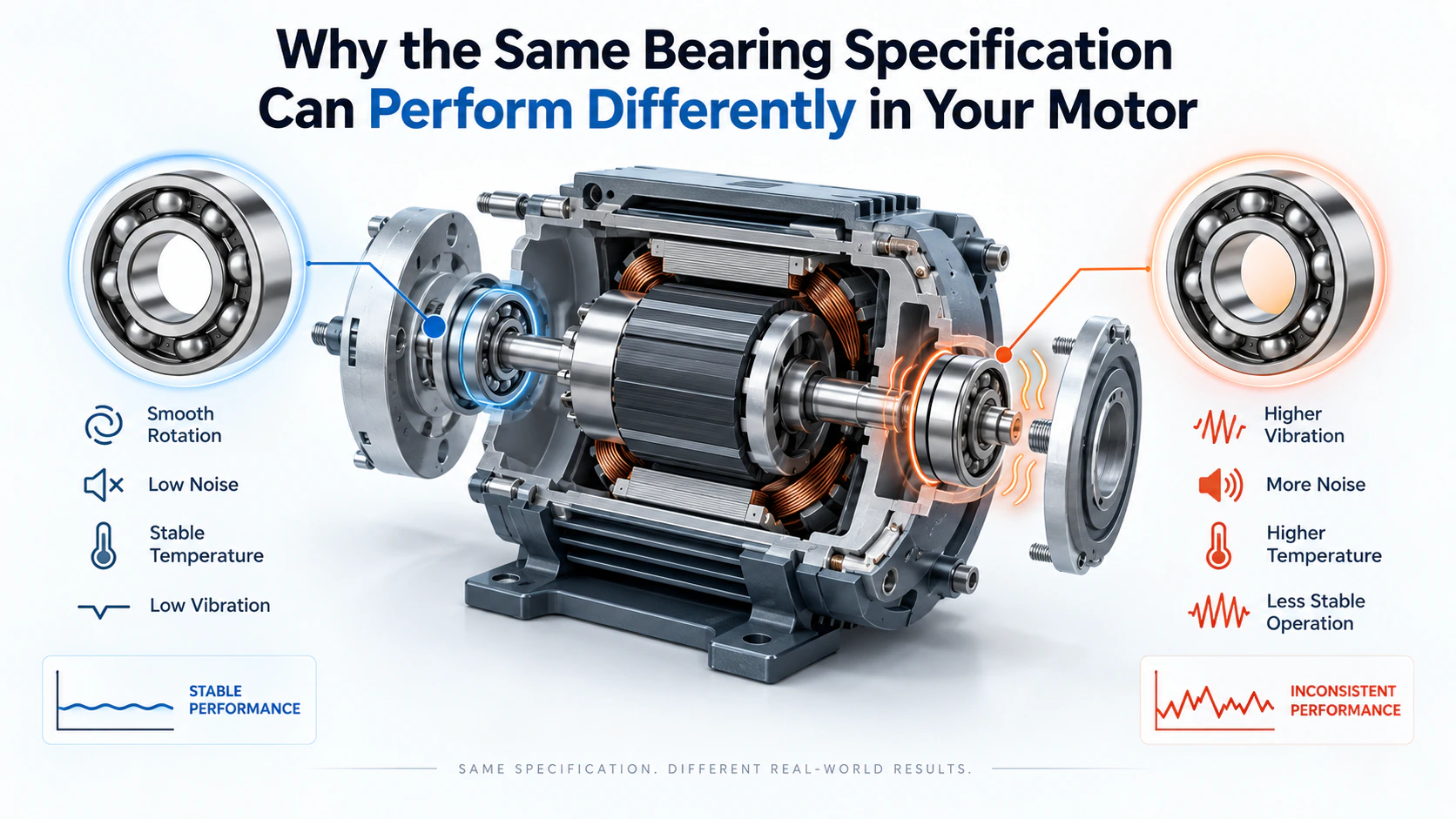
Does the Same Bearing Number Mean the Bearings Are Identical?
Not necessarily.
Bearings with the same basic designation may share standardized principal dimensions, but they can differ in:
- Raceway geometry
- Ball quantity or size
- Internal clearance
- Seal torque
- Shield design
- Cage material
- Steel cleanliness
- Heat treatment
- Grease type and fill amount
- Noise and vibration control
- Load ratings
- Manufacturing tolerances
These differences may affect starting torque, temperature rise, noise, service life and performance after assembly.
This is especially important in electric motors, medical equipment, drones, gearboxes and precision instruments, where a dimensionally interchangeable bearing may not be functionally interchangeable.
Common Bearing-Number Mistakes
1. Quoting only the basic number
Requesting “6205” without closure, clearance or lubricant information allows suppliers to quote different configurations.
2. Assuming ZZ and 2RS are universal designs
These suffixes describe general closure categories, but their exact construction can vary.
3. Treating C3 as a quality grade
C3 is an internal-clearance class, not a general quality level.
4. Applying the multiply-by-five rule to every bearing
Miniature and special bearing series can use different bore-designation conventions.
5. Replacing a bearing based only on dimensions
Matching bore, outside diameter and width does not confirm equivalent torque, noise, clearance, lubrication or speed capability.
6. Dropping manufacturer-specific suffixes
A suffix can identify an internal design, cage, lubricant, tolerance or special customer configuration. Removing it can change the product being ordered.
What Should an OEM Include in a Bearing RFQ?
A reliable RFQ should include more than a bearing number.
Provide:
- Complete current bearing designation
- Bore, outside diameter and width
- Application and equipment type
- Rotational speed and duty cycle
- Radial and axial loads
- Shaft and housing fits
- Operating temperature
- Contamination or moisture exposure
- Seal or shield requirement
- Lubrication requirement
- Internal-clearance requirement
- Noise, vibration or torque requirement
- Required inspection documents
- Sample-validation method
- Drawing or clear photographs when replacing an existing bearing
For miniature applications, review LUMI Bearing’s miniature ball bearing range.
If corrosion resistance is required, material, closures, lubricant and environment should be reviewed together. A stainless designation alone is not a complete corrosion specification. See stainless steel bearings.
Frequently Asked Questions
What does the first digit in a bearing number mean?
In a common designation such as 6205, the first digit identifies the bearing family. The number 6 commonly denotes a single-row deep groove ball bearing. Other bearing families use different numeric or alphanumeric systems.
What does 05 mean in a 6205 bearing?
For the common metric bore-code system, 05 multiplied by five gives a nominal bore diameter of 25 mm.
Are ZZ and 2Z the same?
They are commonly used to describe shields on both sides, but notation and exact shield design can vary among manufacturers. Confirm the catalogue definition before substitution.
Is a 2RS bearing always waterproof?
No. A sealed bearing may offer improved protection against contamination and lubricant leakage, but “2RS” alone does not establish waterproof performance. Seal design, pressure, immersion, speed and operating conditions must be evaluated.
Is C3 better than normal clearance?
Not universally. C3 provides greater initial internal clearance. Whether it is appropriate depends on fits, temperature, speed, load and the required operating clearance.
Can two brands with the same bearing number be interchanged?
They may share principal dimensions, but this does not prove equivalent seals, clearance, lubricant, noise, torque, load ratings or internal design. Compare the complete specifications and validate samples in the actual assembly.
Final Checklist
Before approving a bearing, confirm:
- The complete designation has been recorded
- Bore, outside diameter and width match the drawing
- Every prefix and suffix has been decoded
- Manufacturer-specific codes have been verified
- Seals or shields suit the environment and speed
- Internal clearance suits the fits and temperature
- Lubricant and fill are defined
- Performance requirements are measurable
- Samples will be tested in the real assembly
- Production-lot traceability is agreed
A bearing number is an efficient starting point, but it is not a substitute for an application specification.
If you need help confirming a bearing designation or preparing a quotation, contact LUMI Bearing with the complete bearing number, dimensions, speed, load, temperature, closure, clearance and operating conditions.