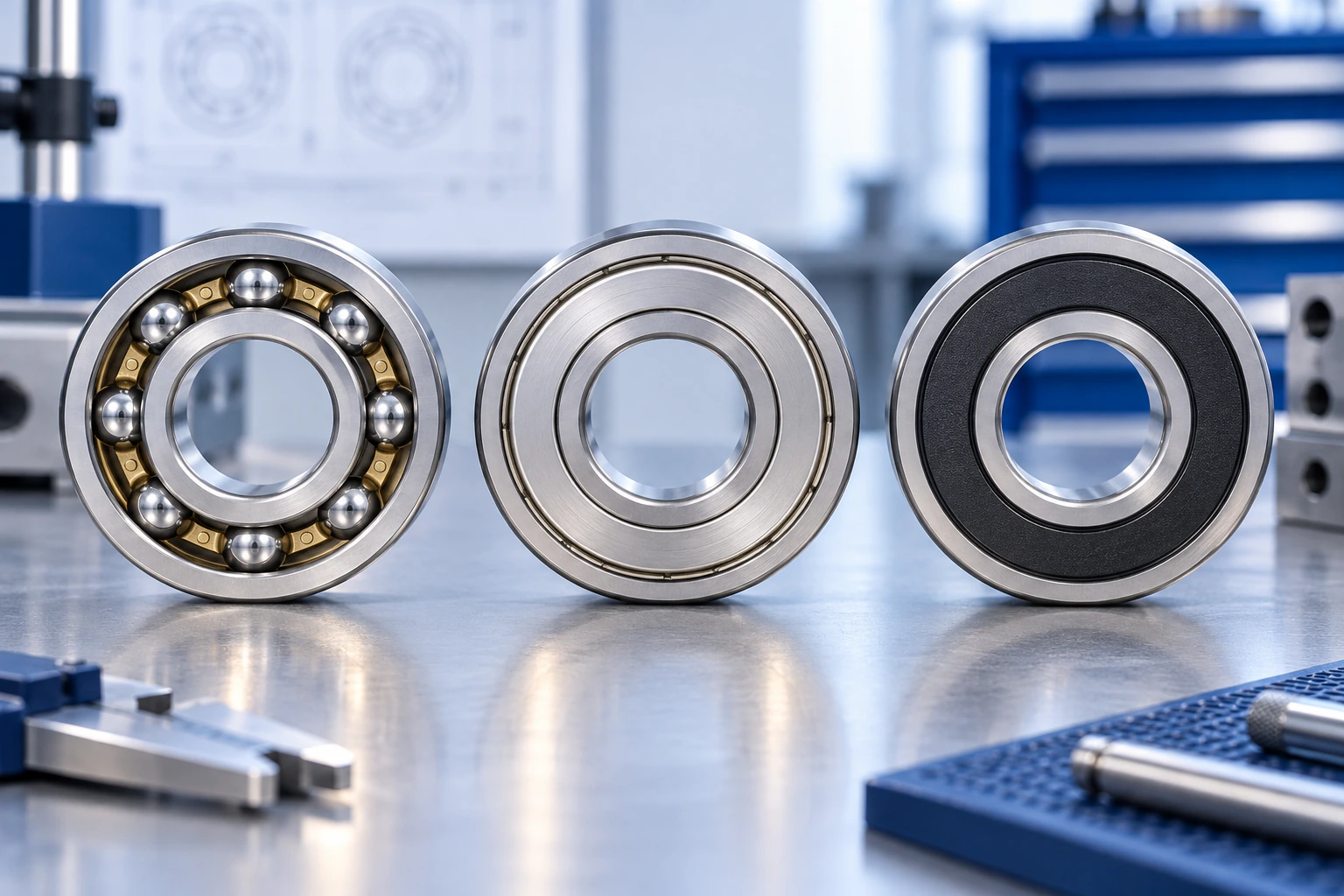
The difference between a ZZ bearing and a 2RS bearing is the closure on each side of the bearing. A ZZ bearing normally has two metal shields. A 2RS bearing normally has two elastomer seals. An open bearing has no integral closures.
That simple difference changes contamination protection, grease retention, starting torque, operating friction, speed capability and maintenance strategy. The correct choice depends on the application—not on the assumption that a more tightly closed bearing is always better.
This guide explains the engineering trade-offs and gives OEM buyers a practical selection process for motors, fans, pumps, gearboxes, robotics and compact equipment.
The Short Answer
Choose ZZ when low friction and speed are important and the environment is reasonably clean. Choose 2RS when protection from dust, moisture or grease leakage is more important than minimum torque. Choose an open bearing when the surrounding assembly already protects the bearing or provides controlled oil or grease lubrication. Always confirm the manufacturer's closure drawing because suffix conventions and seal contact designs can vary.
ZZ vs 2RS vs Open: Quick Comparison
| Feature | Open | ZZ metal shields | 2RS elastomer seals |
|---|---|---|---|
| Integral closure | None | Metal shield on both sides | Elastomer seal on both sides |
| Typical contact | None | Usually non-contact | Often contact; low-friction and non-contact variants also exist |
| Friction and starting torque | Lowest closure drag | Low | Usually higher than ZZ |
| Protection from large particles | Low without external enclosure | Moderate | Good |
| Protection from fine dust or moisture | Low without external enclosure | Limited | Generally better |
| Grease retention | Depends on surrounding system | Good for many clean applications | Stronger retention in contaminated applications |
| External relubrication | Easiest | Limited | Usually not intended |
| Typical use | Clean enclosed systems, oil lubrication | Motors, instruments, fans | Outdoor, dusty or splash-exposed equipment |
This table describes common designs, not a universal rule. Contact the supplier for the actual cross-section, material and speed limitations of the proposed bearing.
What Do the Suffixes Mean?
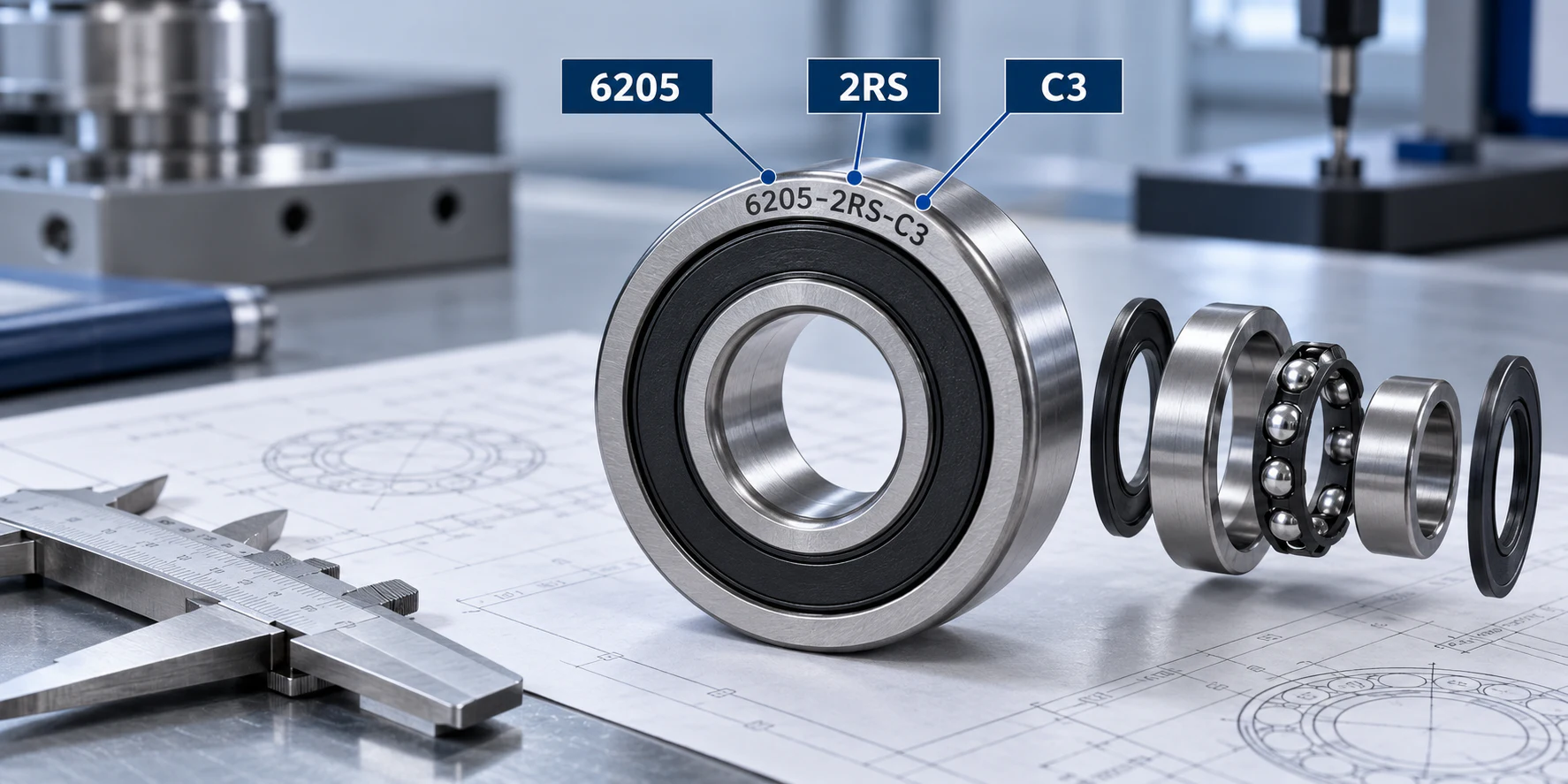
Bearing suffixes are a compact way to identify design features. Common market usage includes:
- Z: one metal shield
- ZZ or 2Z: metal shields on both sides
- RS: one elastomer seal
- 2RS: elastomer seals on both sides
- Open: no shield or seal
Suffixes are not perfectly standardized across every manufacturer. One supplier may use additional letters for a low-friction seal, a non-contact seal, a specific rubber compound or a special groove design. Treat the suffix as a starting point and use the supplier drawing as the controlled definition.
Why the Drawing Matters
When an OEM changes suppliers, the replacement may have the same basic dimensions and a familiar suffix but a different seal lip, shield clearance, grease or internal clearance. Those differences can alter motor current, temperature or acoustic behavior. A qualified alternative should therefore be compared by specification and application testing—not only by model number.
How a Metal Shield Works
A metal shield is fixed to the outer ring and leaves a small gap near the inner ring. Because it usually does not rub against the inner ring, it adds little friction. The narrow path helps retain grease and limits the entry of larger particles.
The shield does not create a pressure-tight barrier. Water, fine dust or cleaning fluid can enter under unfavorable conditions. A shielded bearing should not be described as waterproof.
Advantages of ZZ Bearings
- Low closure friction and starting torque
- Suitable for many high-speed applications
- Good grease retention in clean indoor equipment
- No rubber lip to age from contact heat
- Common availability in motor and instrument sizes
Limitations of ZZ Bearings
- Limited resistance to fine dust, moisture and spray
- Not a substitute for an external housing seal
- Grease can be affected if aggressive fluid reaches the shield gap
- Shield damage during handling may create rubbing or contamination paths
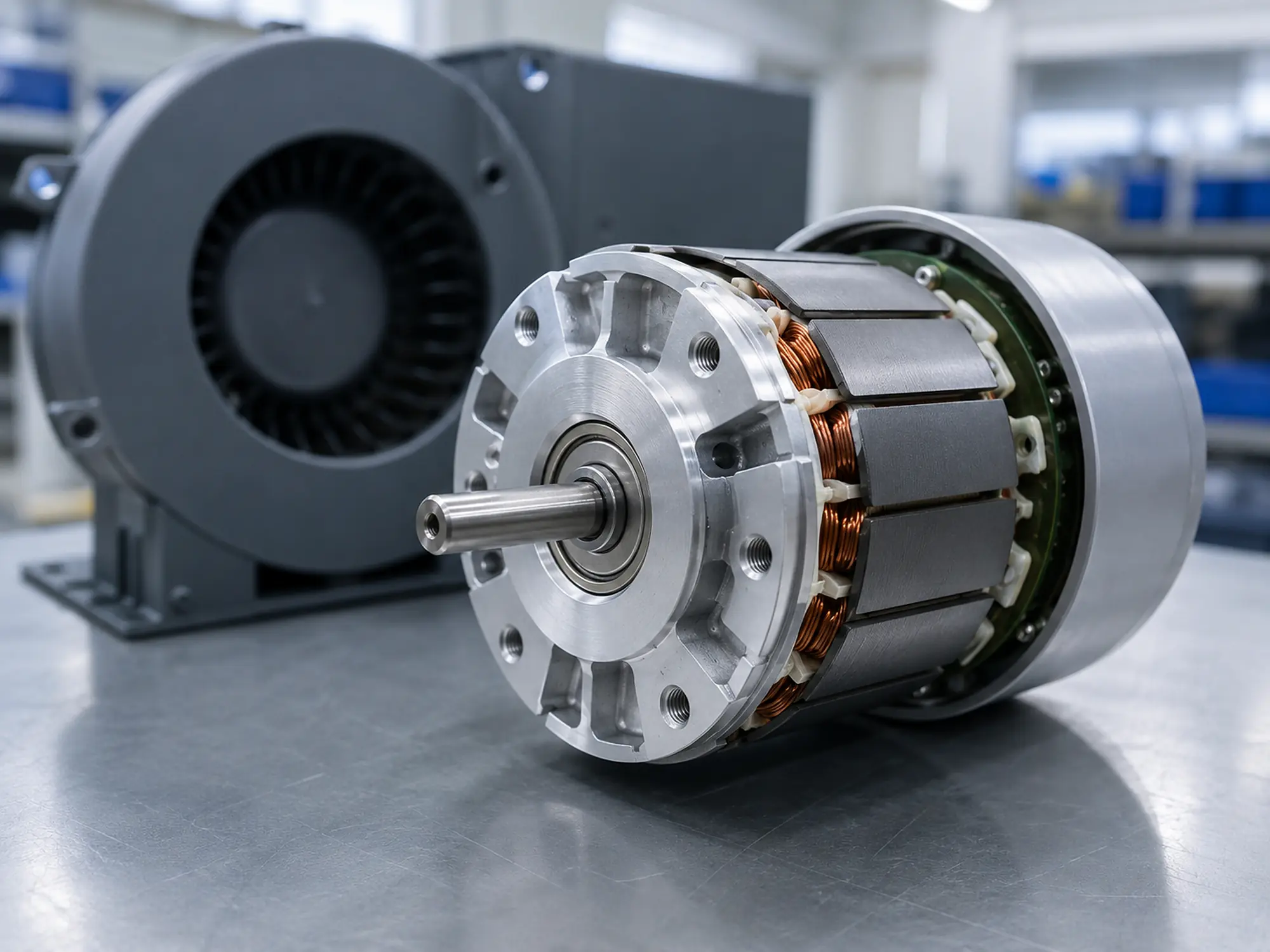
ZZ bearings are frequently considered for electric motors, cooling fans, office equipment, instruments and other applications where the surrounding structure provides additional protection.
How an Elastomer Seal Works
An elastomer seal is normally reinforced and fixed to the outer ring. Its lip runs close to or in contact with a surface on the inner ring. Contact creates a more effective barrier against contaminants and grease leakage, but it also creates friction.
Seal materials and geometry affect temperature capability, chemical resistance, torque and life. Nitrile rubber is common, but other materials may be used for higher temperature or chemical exposure.
Advantages of 2RS Bearings
- Better exclusion of dust and splashed contaminants
- Improved grease retention
- Useful where access for maintenance is limited
- Better protection during handling and installation
- Can simplify the surrounding enclosure in some products
Limitations of 2RS Bearings
- Higher starting and running torque in contact designs
- Additional heat at speed
- Seal-lip wear over time
- Material compatibility must be checked for chemicals and temperature
- Speed capability may be lower than an equivalent ZZ design
2RS bearings are commonly evaluated for dusty machinery, pumps, outdoor mechanisms, agricultural equipment, conveyors and products where contamination control is more important than minimum torque.
When an Open Bearing Is the Better Choice
An open bearing can be the correct engineering choice when the machine already includes a clean sealed housing or a controlled lubrication circuit. With no integral closure, lubricant can flow through the bearing and heat can be managed by the surrounding system.
Examples include gearboxes with oil lubrication, enclosed spindles, test equipment in controlled environments and assemblies with separate labyrinth or contact seals.
The risk is that the bearing has no independent protection during handling or operation. Cleanliness, lubrication quantity and enclosure integrity must be controlled by the machine designer.
1. Compare Friction and Starting Torque
Closure friction matters in low-power motors, battery-operated devices and mechanisms that must start under limited torque. An open bearing has no seal drag. A non-contact metal shield adds very little. A contacting elastomer seal can produce noticeably more resistance, especially at low temperature or after storage.
Do not evaluate torque by turning a bearing with your fingers. Hand feel is subjective and can be influenced by grease distribution. Use a defined torque test or compare current draw in the complete motor under consistent conditions.
Questions for Low-Torque Applications
- What is the maximum allowable starting current?
- Must the product start at low temperature?
- Is the mechanism battery powered?
- Does seal drag materially affect efficiency?
- Can the product enclosure provide contamination protection instead?
If 2RS protection is needed but torque is critical, ask about low-friction seal options and validate the actual design. Do not remove a seal from a production bearing without engineering approval; the grease quantity and closure configuration were selected as a system.
2. Evaluate Speed and Heat Generation
At higher speed, friction becomes heat. The resulting temperature changes lubricant viscosity, seal behavior and internal operating clearance. A design that runs acceptably for a short bench test may overheat during continuous duty.
When comparing ZZ and 2RS, define:
- Continuous and peak speed
- Time at each speed
- Radial and axial loads
- Ambient and enclosure temperature
- Cooling airflow or heat path
- Maximum allowable bearing-seat temperature
- Grease and fill quantity
ZZ is often preferred for clean high-speed motor applications because of lower closure friction. However, speed performance still depends on cage design, accuracy, lubricant and fitting conditions. A ZZ suffix alone does not make a bearing “high speed.”
Unsure whether your application needs ZZ or 2RS?
Send the speed, temperature, contamination conditions and torque limit. LUMI Bearing can help define the closure and sample-test direction.
3. Assess Dust, Moisture and Chemical Exposure
Describe the environment precisely. “Dusty” can mean occasional household dust or continuous abrasive powder. “Wet” can mean high humidity, intermittent splash or direct washdown. These are not equivalent.
Create an exposure profile:
- Particle type and approximate size
- Exposure frequency and duration
- Humidity, condensation or splash direction
- Cleaning process and chemicals
- Shaft orientation and gravity effects
- Whether the product enclosure has its own seal
- Consequence of contamination entering the bearing
A 2RS bearing generally provides more protection than ZZ, but an integral bearing seal is not automatically adequate for pressurized washdown or complete immersion. The surrounding product may still need a shaft seal, labyrinth or protective cover.
Stainless Steel Is a Separate Decision
Closure choice and corrosion resistance are related but distinct. A rubber-sealed bearing made from standard bearing steel can still corrode if water reaches exposed surfaces. A stainless-steel bearing may improve corrosion resistance, but the exact steel grade, load capacity, lubricant and environment must be reviewed. Do not use “stainless” as a substitute for an environmental sealing strategy.
4. Consider Grease Retention and Lubrication Strategy
Most small ZZ and 2RS bearings are supplied greased for life, but “for life” means for the expected service interval under the specified operating conditions. Temperature, speed, load, contamination and grease chemistry all influence lubricant life.
2RS closures generally retain grease more effectively. ZZ closures retain grease adequately in many clean applications while producing less drag. Open bearings allow external lubrication but require the machine to control lubricant supply and contamination.
Ask the supplier to confirm:
- Grease product or agreed performance specification
- Fill quantity or fill range
- Temperature and speed suitability
- Compatibility with seals and surrounding materials
- Noise or torque requirements
- Shelf-life and storage recommendations
For low-noise motors, changing the closure without reviewing the grease can lead to the wrong conclusion. A higher-viscosity grease or excessive fill may raise torque more than the shield itself.
5. Review Temperature and Seal Material
Temperature affects both lubricant and elastomer. At low temperature, grease and seal lips can increase starting torque. At high temperature, grease oxidation and seal aging accelerate.
The application specification should distinguish:
- Ambient temperature
- Bearing-seat or ring temperature
- Short-duration peak temperature
- Storage and transport temperature
- Thermal cycling frequency
If chemical exposure is possible, identify the actual fluid and concentration. Oil, fuel, cleaning agents, steam and process chemicals affect elastomers differently. The supplier should confirm material compatibility rather than making a generic “chemical resistant” claim.
6. Account for Noise and Vibration
Closure selection can influence noise through seal contact, grease distribution and contamination control. ZZ may reduce friction-related noise in a clean motor. 2RS may prevent particles from entering and causing later noise in a harsher environment. A defined quality and validation method is more reliable than comparing bearings by hand feel.
The complete motor should be tested because the bearing interacts with rotor balance, housing resonance, internal clearance and assembly preload. Define the measurement speed, load, equipment and acceptance limit. Compare bearings after consistent run-in time because grease redistribution can change the early result.
For a complete selection workflow, see How to Choose Miniature Ball Bearings for Electric Motors.
7. Check Installation and Handling Risks
Closures protect internal surfaces, but they can also be damaged during installation. A press tool that contacts a shield or seal may dent it, create rubbing or open a contamination path.
Installation preparation should include:
- A mounting sleeve that contacts the correct ring face
- Clean fixtures without sharp edges
- Controlled press force
- Verification that no tool contacts the closure
- Protection from metal chips and adhesive
- Correct bearing orientation if the two sides differ
- Post-assembly rotation, current or noise check
Do not wash a greased ZZ or 2RS bearing unless the supplier has approved a specific process. Solvent can enter the bearing, dilute the grease or damage the seal.
Application-Based Recommendations
Small Electric Motors and Cooling Fans
ZZ is often a strong starting point for small electric motors when the enclosure is clean and low torque, speed and noise are priorities. Use 2RS when the motor is exposed to dust or moisture. Validate current draw, temperature and acoustic performance in the complete motor.
Pumps
2RS may provide better protection from incidental moisture, but the bearing seal is not a replacement for the pump's fluid sealing system. Review leakage paths, corrosion risk, shaft seal performance and temperature.
Gearboxes
Open bearings may be appropriate in a clean oil-lubricated gearbox application. Shielded or sealed bearings can isolate incompatible greases or contaminants, but they may also prevent the intended oil flow. Confirm the lubrication architecture.
Robotics and Automation
The choice depends on torque sensitivity, duty cycle and environmental exposure. Compact joints may prioritize low friction and positional repeatability, while mobile or warehouse equipment may need stronger contamination protection.
Outdoor Equipment
2RS is commonly evaluated, often together with corrosion-resistant material and an external cover. Condensation and temperature cycling should be considered, not only direct rain.
Food, Medical and Clean Applications
Do not select only by closure. Review lubricant approval, material compliance, cleaning chemicals, particle generation and validation requirements. “Sealed” does not automatically mean hygienic or suitable for medical use.
A Five-Step Selection Method
Step 1: Define the Environment
Record dust, moisture, chemical and cleaning exposure. Note whether the machine provides an external enclosure.
Step 2: Define Performance Limits
Specify speed, load, starting torque, temperature, noise and expected life.
Step 3: Select the Initial Closure
- Start with open for a clean externally lubricated system.
- Start with ZZ for a clean, low-friction, grease-filled application.
- Start with 2RS for greater contamination protection and grease retention.
Step 4: Confirm the Complete Specification
Review the proposed miniature deep-groove bearing material, clearance, precision, cage, lubricant, seal material, marking and packaging. Obtain the supplier drawing.
Step 5: Test in the Actual Product
Compare starting torque, running temperature, noise, leakage and contamination performance. Use production-intent components and installation fixtures. Document the approved configuration.
Procurement Questions to Send a Supplier
- Is the shield non-contact?
- Is the seal contact, low-friction or non-contact?
- What is the seal material?
- What lubricant and fill range are used?
- What speed and temperature assumptions apply?
- What is the radial internal clearance range?
- Can the supplier provide a cross-sectional drawing?
- Which characteristics are checked during production and shipment inspection?
- How are lots identified and traced?
- Will changes to seal, grease or internal design require customer notification?
These questions prevent a model suffix from carrying more meaning than it actually does.
Common Mistakes
Assuming 2RS Is Always Better
Better protection may come with more torque and heat. If the enclosure is already clean and sealed, the additional friction may not provide value.
Assuming ZZ Is Waterproof
The shield gap is not a fluid-tight seal. Splash, condensation and fine contaminants can still enter.
Ignoring the Lubricant
Closure and grease work together. A change in grease type or fill can alter torque, temperature and noise even when the closure remains the same.
Approving by Hand Feel
Manual rotation is not a controlled test. Use torque measurement or complete-product performance data.
Treating Suffixes as Universal
Manufacturer conventions differ. Approve the drawing and technical specification, not only “ZZ” or “2RS.”
FAQ
Which is faster, ZZ or 2RS?
ZZ normally has less closure friction and is often suitable for higher-speed clean applications. The actual speed capability also depends on bearing geometry, cage, lubricant, clearance, load and heat dissipation.
Is a 2RS bearing waterproof?
No universal 2RS bearing should be assumed waterproof. It generally provides better resistance to dust and splash than ZZ, but immersion, pressure washing or aggressive fluids may require an external sealing system.
Can I remove the seals from a 2RS bearing?
Removing seals changes contamination protection and grease retention and may damage the bearing. Use an approved open or shielded variant instead of modifying production bearings without engineering validation.
Can ZZ and 2RS bearings have the same dimensions?
Yes. Many series share the same boundary dimensions, but internal design, grease, clearance and performance can differ. Dimensional interchangeability does not prove application equivalence.
Does 2RS last longer than ZZ?
It may last longer in a contaminated environment because it excludes more debris and retains grease. In a clean high-speed application, additional seal heat could be disadvantageous. Life depends on the full operating condition.
What is the best closure for a low-noise motor?
There is no universal answer. ZZ often offers low friction, while 2RS can prevent contamination-related noise. Test the closure together with lubricant, clearance, fits and the complete motor.
Should an oil-lubricated gearbox use open bearings?
Often, but not always. Open bearings allow oil flow. The gearbox designer must verify oil delivery, contamination control and whether any bearing position needs isolation from another lubricant or environment.
Conclusion
The ZZ versus 2RS decision is a balance. ZZ favors low closure friction in reasonably clean systems. 2RS favors contamination resistance and grease retention. Open bearings favor externally protected or lubricated assemblies.
The most defensible OEM decision is based on defined speed, torque, temperature, exposure and maintenance requirements, followed by testing in the real product. Confirm the supplier's drawing and lubricant specification, then preserve the approved configuration through lot traceability and change control.