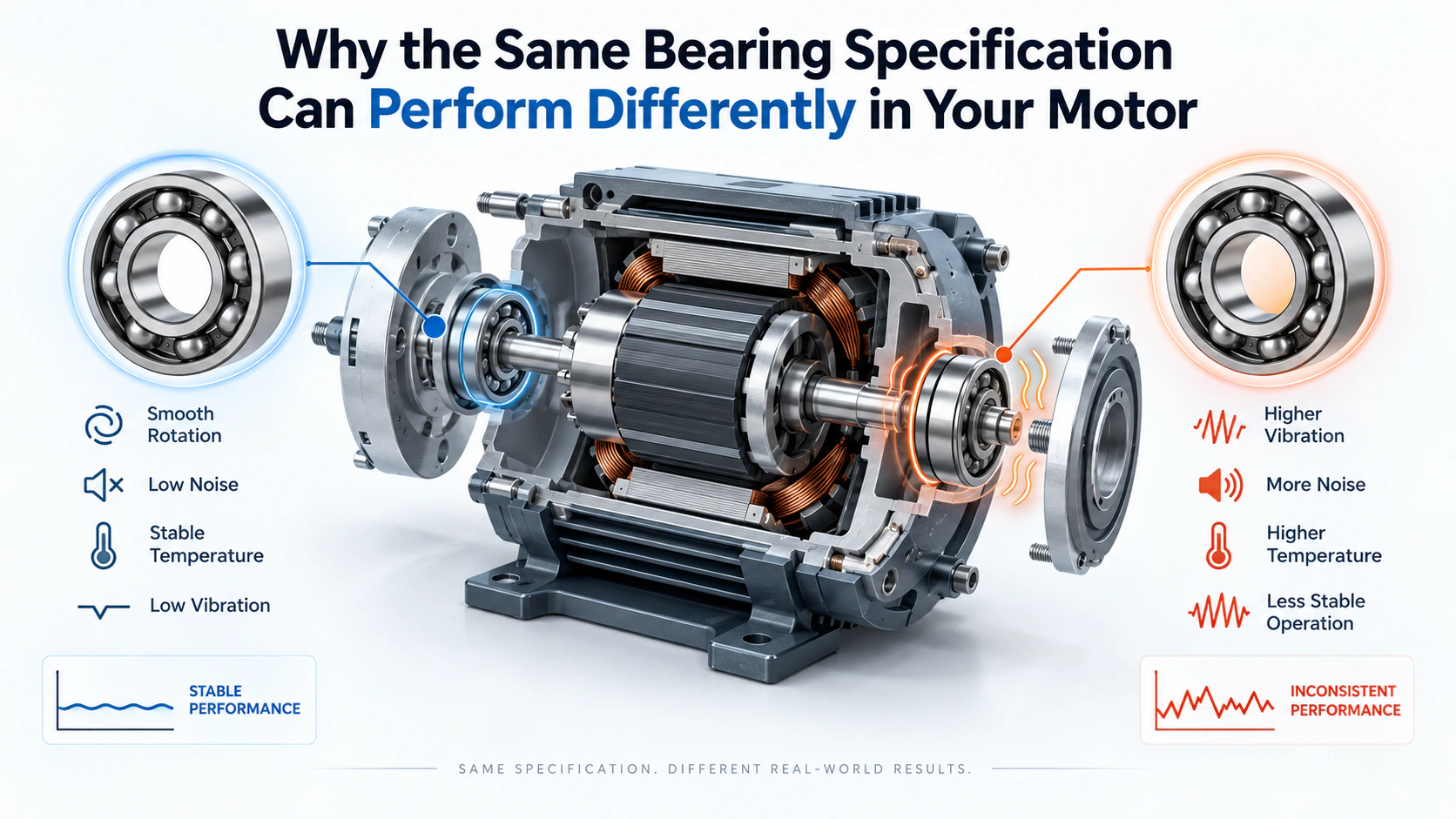
Selecting a miniature ball bearing for an electric motor is not simply a matter of matching the shaft diameter. The bearing must operate as part of a complete system: shaft, housing, rotor, lubricant, temperature range, duty cycle, assembly process and operating environment. A bearing that looks correct on a drawing can still create excessive noise, heat or early wear after it is pressed into the motor.
For OEM teams, the most reliable selection process starts with the requirements of the small electric motor application and works backward to the bearing specification. That means defining loads, speed, life target, noise limits, temperature, contamination, fitting conditions and lubrication before approving a model for production.
The Short Answer
To choose a miniature bearing for an electric motor, first confirm the required dimensions, radial and axial loads, maximum and continuous speed, operating temperature, noise target and expected service life. Then select the bearing type, internal clearance, precision level, cage, lubricant and shield or seal arrangement. Finally, validate the choice in the actual motor through sample testing, assembly trials and pre-production inspection.
Motor Bearing Selection Checklist
| Decision area | Information to define | Why it matters |
|---|---|---|
| Envelope | Bore, outside diameter, width and shoulder geometry | Determines whether the bearing can be mounted and retained correctly |
| Load | Radial load, axial load, shock and belt or gear forces | Affects bearing type, size and calculated rating life |
| Speed | Continuous speed, peak speed and acceleration profile | Influences heat generation, lubricant and cage selection |
| Accuracy | Runout, rotor stability and shaft alignment | Affects vibration, noise and motor performance |
| Clearance | Fits, temperature gradient and preload strategy | Too little clearance may cause heat; too much may increase noise and movement |
| Environment | Dust, moisture, chemicals and washdown exposure | Determines whether open, shielded or sealed construction is appropriate |
| Lubrication | Grease or oil type, fill and life expectation | Strongly affects torque, temperature, noise and durability |
| Assembly | Pressing method, force path and tolerance stack | Incorrect mounting can damage a suitable bearing before operation begins |
1. Start with the Motor, Not the Bearing Catalogue
A catalogue number describes a component. It does not describe how that component will behave in your motor. Two motors using a bearing with the same boundary dimensions can need different internal clearance, lubricant or closure because their operating conditions differ.
Before requesting samples, prepare an application brief containing:
- Motor type and end use
- Shaft and housing dimensions with tolerances
- Horizontal or vertical shaft orientation
- Continuous and peak rotational speed
- Estimated radial and axial loads
- Operating and storage temperature ranges
- Duty cycle, starts and stops, and expected operating hours
- Target noise or vibration level and the measurement method
- Exposure to dust, moisture or process chemicals
- Required regulatory or material restrictions
- Assembly method and expected interference fits
- Annual demand, sample quantity and production schedule
This brief is more useful to a bearing supplier than a request such as “please quote a high-speed 608 bearing.” It also reduces the risk that purchasing, engineering and quality teams are evaluating different assumptions.
Practical Field Note
During sample-to-production qualification, many apparent bearing problems are actually system problems. A shaft shoulder may be out of square, a press fixture may transfer force through the balls, or a motor housing may remove too much internal clearance. A good investigation therefore compares the unmounted bearing, the mounted assembly and the running motor instead of judging only one stage.
2. Confirm Dimensions and Tolerance Interfaces
Miniature bearings are sensitive to small dimensional changes because the available internal space is limited. Start with the nominal bore, outside diameter and width, but do not stop there. Confirm shaft tolerance, housing tolerance, shoulder diameter, fillet radius, shaft roundness and housing alignment.
The bearing rings need adequate support without interference from a shoulder radius. If the shaft fit is too loose, the inner ring may creep. If the fit is too tight, the ring can expand enough to reduce internal clearance and increase operating temperature.
ISO 492 defines dimensional and geometrical tolerance concepts for radial bearings. In an OEM drawing, however, the bearing tolerance class must still be considered together with the shaft and housing tolerances. A high-precision bearing cannot compensate for an inaccurate seat.
Questions to Ask Before Freezing the Drawing
- Which ring rotates relative to the load direction?
- Is the fit intended to prevent creep or to allow axial displacement?
- What are the minimum and maximum interference values after tolerance stacking?
- Will temperature cause the inner and outer rings to expand differently?
- Can the assembly fixture apply force only to the ring being fitted?
For compact motors, it is helpful to review the worst-case tolerance stack rather than only nominal values. The minimum residual clearance after fitting and at operating temperature is often more important than the catalogue clearance before mounting.
3. Define Radial Load, Axial Load and Life Expectations
Deep-groove ball bearings are widely used in small electric motors because they can support radial load and moderate axial load in both directions. That does not mean every deep-groove bearing is interchangeable.
Identify all load sources:
- Rotor mass and magnetic forces
- Belt tension, fan load or gear mesh force
- Coupling misalignment
- Axial thrust from a fan, impeller or helical gear
- Shock during transport or operation
- Preload from springs, washers or assembly geometry
Basic rating life can be evaluated using the framework in ISO 281. Its basic rating life is associated with 90% reliability for a sufficiently large population of apparently identical bearings under conventional assumptions. This is a calculation framework, not a service-life guarantee. Real service life can be shortened by poor lubrication, contamination, corrosion, electrical erosion, mounting damage or misalignment.
For a purchasing specification, avoid writing only “long life.” State the intended operating hours, load and speed profile, temperature and acceptable failure criteria. A supplier can then recommend a realistic validation method.
When Axial Load Deserves Extra Attention
In a very small bearing, an axial load that looks modest in absolute terms may be significant relative to the bearing size. Repeated reversing thrust, excessive spring preload or misaligned assembly can increase contact stress and friction. If the motor has meaningful axial load, provide its direction, magnitude and duty cycle to the supplier.
4. Separate Continuous Speed from Maximum Speed
“High speed” should be defined numerically and in context. A bearing running briefly at a peak speed is different from one operating continuously at that speed in a warm enclosed motor.
Speed capability depends on more than the bearing series. Important variables include:
- Bearing size and internal geometry
- Cage material and design
- Lubricant base oil viscosity and thickener
- Grease quantity and distribution
- Seal contact and friction
- Internal clearance or preload
- Ring accuracy and raceway finish
- Heat dissipation from the motor housing
A lubricant that provides strong film thickness at moderate speed may create excessive torque at very high speed. A low-viscosity lubricant may reduce torque but must still protect the contacts at the expected load and temperature.
For qualification, record continuous speed, peak speed, duration at peak, acceleration rate, ambient temperature and the temperature measured near the bearing seat. Compare running temperature after stabilization, not only the first few minutes.
Need a bearing recommendation for a motor project?
Send your shaft size, operating speed, load, temperature and noise requirements. LUMI Bearing can review the application information before preparing samples.
5. Set a Measurable Noise and Vibration Requirement
Low-noise performance is a system result. Bearing raceway quality, ball grade, cleanliness, lubricant, clearance, motor balance, fits and assembly damage can all affect what the customer hears.
Instead of asking for a “silent bearing,” define:
- Measurement equipment or method
- Rotational speed during the test
- Axial or radial test load
- Frequency bands or vibration classes if applicable
- Maximum acceptable value
- Sample size and acceptance rule
- Whether the test applies to loose bearings or complete motors
NSK's technical material on low-noise motor bearings illustrates why lubricant and bearing design must be considered together for electric motor noise. The practical lesson for OEMs is to compare candidate bearings under a repeatable method, align the checks with a clear quality and validation plan, and then verify them again in the actual motor.
Loose-Bearing Test vs Motor-Level Test
A factory vibration test can screen bearing consistency, but it cannot reproduce every resonance and force in the finished product. Motor-level testing should therefore be part of approval when acoustic performance is important. Keep the motor build, fixture, microphone position and background conditions consistent between comparisons.
6. Choose Internal Clearance After Considering Fits and Heat
Radial internal clearance is the internal movement available before mounting. The operating clearance is what remains after interference fits, temperature differences and elastic deformation.
Too little operating clearance can lead to high torque, rapid temperature rise and reduced lubricant life. Too much clearance can reduce rotational stability and increase noise. The correct choice is application-specific.
Important questions include:
- How much will the shaft fit expand the inner ring?
- How much will the housing fit compress the outer ring?
- Will the shaft run hotter than the housing?
- Is an axial spring used to control noise or end play?
- Does the motor require a defined preload?
Do not substitute a tighter clearance class merely to reduce measured play without checking temperature and fitting effects. For difficult applications, ask the supplier to document the clearance range and verify mounted running temperature during the trial.
7. Select Open, Shielded or Sealed Construction
Closures control the balance between contamination protection, grease retention and friction.
Open Bearings
Open bearings have no integral shield or seal. They offer minimal closure drag and allow external lubrication, but they depend on a clean surrounding system. They are appropriate when the motor housing itself provides protection or when oil lubrication is managed separately.
ZZ Metal-Shielded Bearings
ZZ bearings normally use a metal shield on both sides. The shield is generally non-contact, so torque is low. It helps retain grease and excludes larger particles but is not intended to provide the same moisture or fine-contaminant protection as a contacting rubber seal.
2RS Rubber-Sealed Bearings
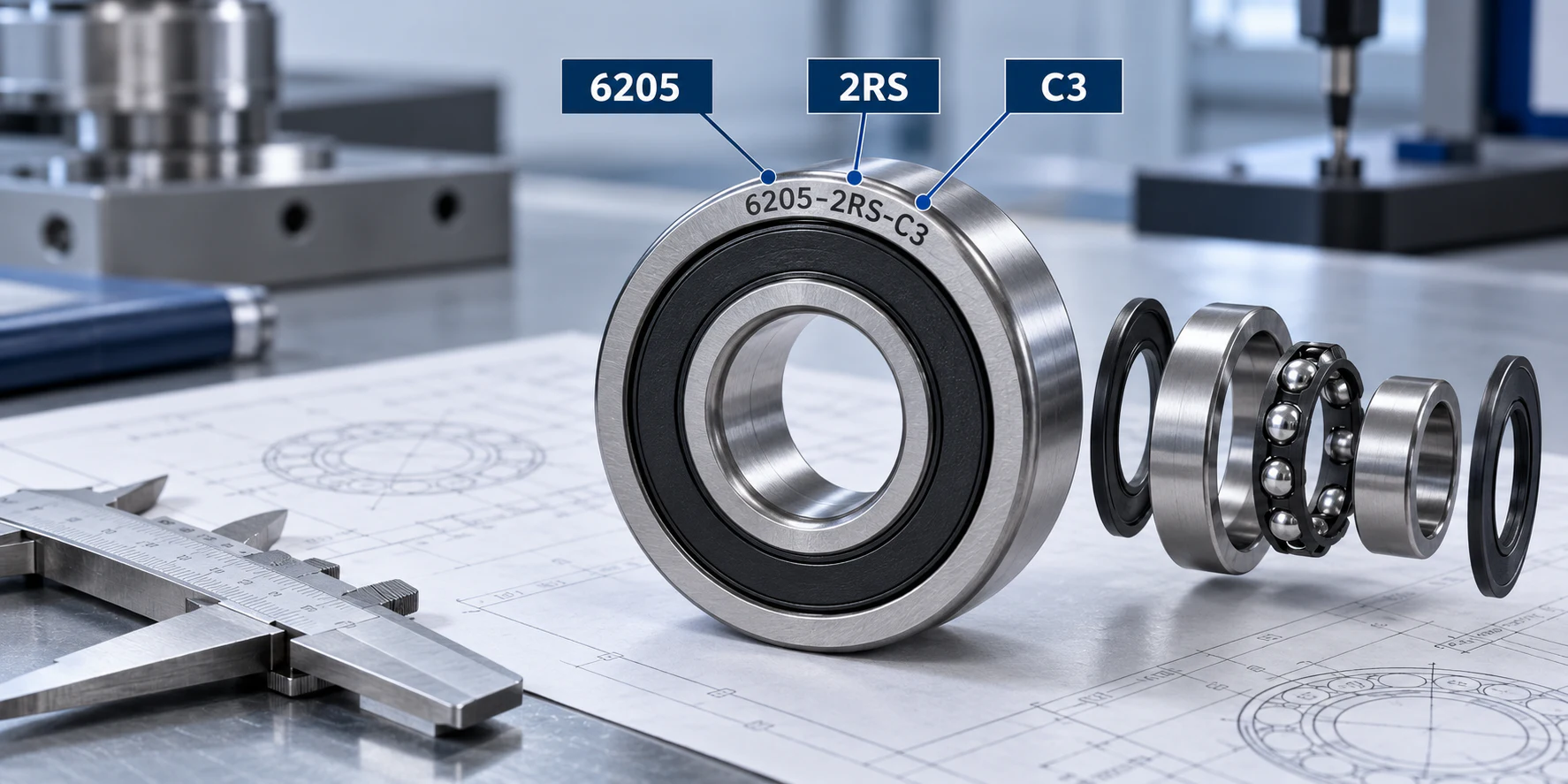
2RS bearings normally use elastomer seals on both sides. Contact-seal designs improve grease retention and contamination resistance, but seal friction can increase torque and temperature. Exact seal construction differs by manufacturer, and some low-friction or non-contact seal variants exist. Confirm the supplier's drawing rather than relying only on the suffix.
For a detailed comparison, see ZZ vs 2RS Bearings: How to Choose Shields, Seals or Open Bearings.
8. Match the Lubricant to Speed, Temperature and Life
Grease is not an accessory specification. In small motor bearings, it can dominate starting torque, running temperature, acoustic behavior and life.
Provide the supplier with:
- Minimum, normal and maximum temperature
- Continuous and peak speed
- Starting-torque limitation
- Noise requirement
- Expected operating life
- Orientation and vibration environment
- Compatibility or regulatory requirements
Also specify fill quantity or an agreed supplier standard. Too much grease can churn and raise temperature; too little may reduce life. For precision applications, grease distribution after assembly and a controlled running-in process may be relevant.
If the motor is used near plastics, adhesives or sensitive electronics, review lubricant compatibility and outgassing requirements. If the application is food, medical or clean-environment related, do not assume a general-purpose grease satisfies the required compliance regime.
9. Decide the Necessary Precision Level
A higher tolerance class can reduce dimensional and rotational variation, but it should be selected for a defined reason. Applications that may justify tighter control include high-speed rotors, low-vibration instruments, encoders and systems with strict runout limits.
The full system still matters. Shaft roundness, shoulder squareness, housing alignment, rotor balance and assembly cleanliness can overwhelm the benefit of a higher-grade bearing. Ask which measurable motor requirement the precision class is intended to protect.
For OEM sourcing, the drawing should identify critical-to-quality characteristics rather than relying on a broad phrase such as “high precision.” Critical characteristics might include bore and outside-diameter tolerance, radial runout, clearance range, vibration level, lubricant, closure and marking.
10. Prepare the Installation Process Before Samples Arrive
Installation preparation is part of bearing selection. A sample can be damaged during the first assembly and incorrectly rejected as a product defect.
Use these basic controls:
- Keep bearings sealed until the assembly area is ready.
- Clean the shaft, housing, fixture and work surface.
- Check seats for burrs, dents and contamination.
- Apply mounting force to the ring being fitted; do not transmit force through the rolling elements.
- Use a controlled press rather than impact where possible.
- Confirm the bearing is seated against the correct shoulder.
- Avoid direct handling of raceways or contamination of seals.
- Measure motor current, noise and temperature after assembly.
The Schaeffler mounting handbook provides broader mounting principles. For a miniature motor line, these principles should be translated into a simple fixture drawing and operator work instruction.
11. Validate Samples with a Defined Test Plan
Avoid approving samples only because the motor starts and sounds acceptable. Build a comparison plan that reflects production risk.
Suggested Qualification Stages
Incoming sample inspection
- Confirm package and model identification
- Measure critical dimensions and clearance
- Review closure, grease and marking
- Record baseline vibration or noise data
Assembly trial
- Use production-intent shafts, housings and fixtures
- Record press force if available
- Check seating, end play and rotor freedom
- Inspect a sample after disassembly for mounting marks
Motor performance test
- Current draw and starting behavior
- Noise and vibration at defined speeds
- Temperature rise to stabilization
- Performance through starts, stops and direction changes
Durability or accelerated test
- Apply representative load, speed and temperature
- Define inspection intervals and failure criteria
- Compare candidate and control samples under the same method
Pre-production confirmation
- Approve the final drawing and specification
- Retain a golden sample where appropriate
- Confirm packaging, labels and traceability
- Agree on shipment inspection records and change notification
If a test fails, isolate whether the cause is the bearing, motor component, assembly process or test setup. ISO 15243 provides standardized terminology for bearing damage and failure modes, which helps teams describe observations consistently.
12. What to Include in an RFQ for Motor Bearings
A complete RFQ improves both technical accuracy and quotation speed. Include:
- Bearing model or required boundary dimensions
- Drawing with shaft and housing tolerances
- Continuous and maximum speed
- Radial and axial load information
- Operating temperature
- Noise and vibration target
- Clearance and precision requirements, if already defined
- Shield or seal preference
- Lubricant requirements
- Material or compliance requirements
- Sample quantity and annual forecast
- Packaging, marking and traceability needs
- Current problem, if replacing an existing bearing
If some data is unknown, say so. A supplier can help identify what needs to be tested, but it should not invent application conditions.
Common Selection Mistakes
Selecting Only by Catalogue Speed
Catalogue limits are not a substitute for testing inside an enclosed motor. Lubricant, seals, preload and heat dissipation can change the result.
Treating All Bearings with the Same Dimensions as Equivalent
Internal geometry, clearance, lubricant, cage, seal design and manufacturing control may differ even when boundary dimensions match.
Tightening the Fit to Solve Every Noise Problem
Excessive interference can remove operating clearance and create heat. Diagnose shaft, housing, rotor balance, lubricant and assembly before changing the fit.
Ignoring Production Variation
One successful sample does not prove process capability. Define critical characteristics, inspect a representative pre-production lot and monitor shipment consistency.
FAQ
What type of bearing is most common in small electric motors?
Miniature deep-groove ball bearings are common because they support radial load, moderate axial load and high rotational speed in a compact format. The correct size, clearance, lubricant and closure still depend on the motor design.
Should a high-speed motor use ZZ or 2RS bearings?
ZZ metal shields often produce less closure friction, which can suit clean, high-speed applications. 2RS seals generally provide better contamination protection and grease retention but may increase torque and heat. Validate the actual seal design in the motor.
Does a higher precision class always reduce motor noise?
No. Bearing accuracy can help, but motor noise also depends on raceway quality, lubricant, clearance, shaft and housing accuracy, rotor balance and mounting. A system-level test is required.
How do I choose bearing internal clearance?
Estimate how interference fits and temperature differences will change the initial clearance. The goal is a suitable operating clearance after mounting and during operation. Do not choose solely from the loose-bearing feel.
Can bearing life be guaranteed from a catalogue calculation?
No. ISO 281 calculations support comparison under defined assumptions, but actual service life is affected by lubrication, contamination, mounting, alignment, corrosion, electrical current and operating variation.
What information should I send to a bearing supplier?
Send the bearing dimensions or model, shaft and housing tolerances, speed, loads, temperature, noise target, environment, lubricant preference, sample quantity and annual demand. Photos or drawings of the assembly can also clarify the application.
How many samples should an OEM test?
There is no universal number. The sample size should reflect application risk, production volume, variation and test cost. Start with engineering samples, then validate a representative pre-production lot under a written acceptance plan.
Conclusion
The best miniature motor bearing is the one that remains stable after fitting, reaches the required speed without excessive heat, meets the motor's acoustic target and can be produced consistently. That result comes from matching the bearing specification to the complete application—not from selecting a catalogue number in isolation.
Define the requirements first, compare samples under repeatable conditions and preserve the final decisions in a controlled drawing. This approach gives engineering, purchasing and quality teams a common basis for approval and future shipment inspection.