Bearing inventory does not become risk-free because the parts have not yet run. Packaging condition, humidity, floor and wall exposure, stacking, handling, lubricant, corrosion protection, traceability, and time in storage can all affect the release decision. The right control is not a universal expiry date. It is a product-specific storage and inspection process agreed by the OEM and supplier.
This is especially important when one warehouse holds open bearings, shielded bearings, sealed bearings, and products with different lubricant or preservation systems. A date rule copied from one product may not apply to another. Procurement should preserve the supplier's controlled condition, record what was received, and define when engineering review is required before production use.
Record the product before deciding how to store it
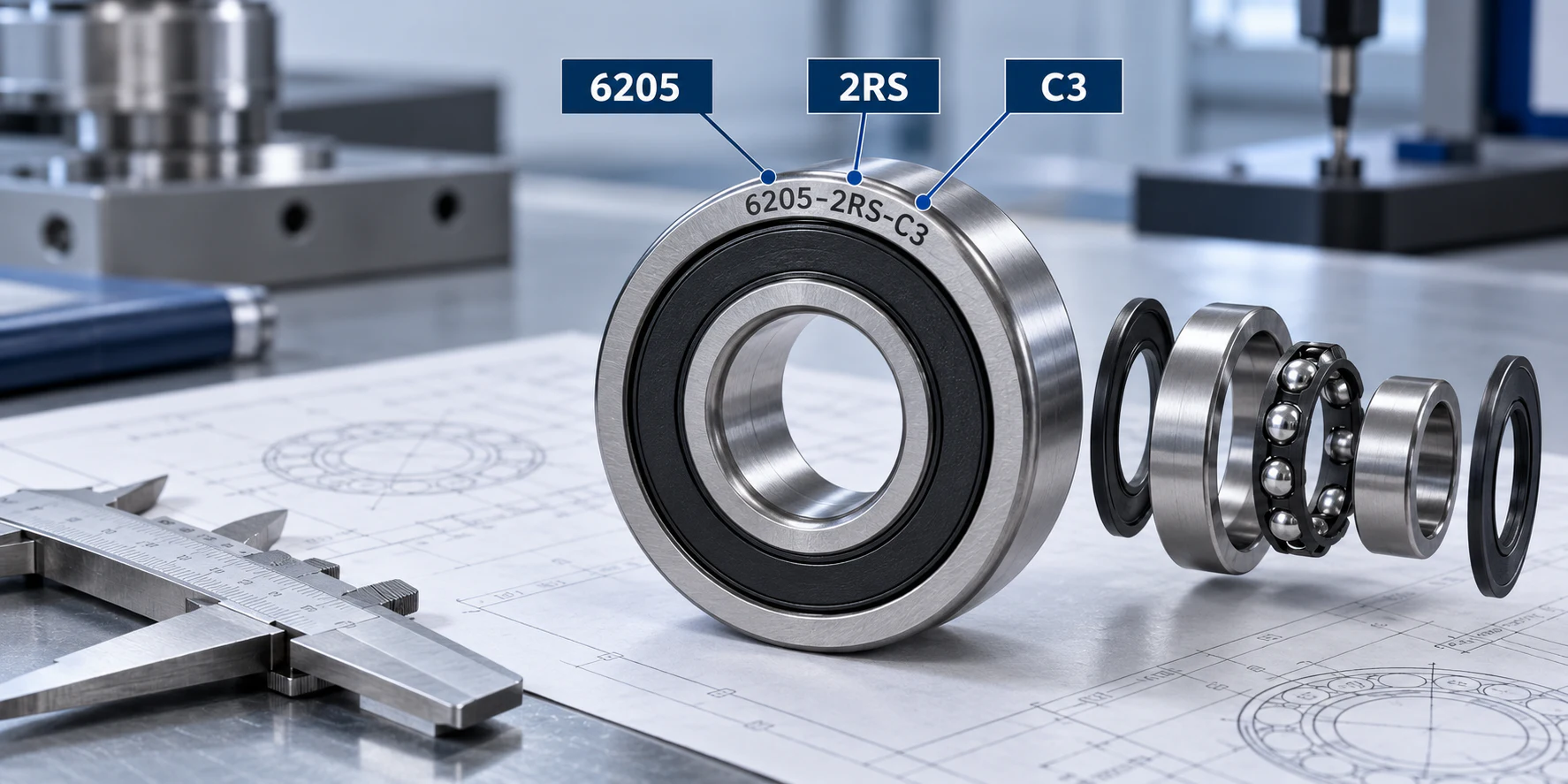
Start with the exact bearing designation and construction. Record whether the bearing is open, shielded, or sealed; whether it contains grease or another lubricant; the supplier lot or traceability code; production or packaging date when provided; quantity; receipt date; packaging configuration; and any customer-specific preservation requirement.
Do not treat “sealed” as proof that storage conditions no longer matter. The closures, internal lubricant, rings, external surfaces, packaging, and labels still have product-specific controls. Likewise, an open bearing may arrive with rust preventative and secure packaging intended to preserve its delivered condition until controlled assembly.
NTN's storage guidance states that bearings are supplied with rust preventative and secure packaging and gives practical direction for the storage environment. It addresses humidity, keeping packages off the ground, and avoiding excessive box stacking. Those principles support a disciplined warehouse process, but they do not establish a LUMI shelf-life period for every bearing and lubricant combination.
Keep original packaging intact until controlled use
Original supplier packaging provides more than a convenient container. It can help preserve cleanliness, corrosion protection, identification, lot linkage, and count integrity. Keep packages closed until the planned issue point unless an approved inspection requires opening them.
If a package is opened, record who opened it, why, when, under what conditions, and how the remaining parts were reprotected. Do not return exposed bearings to inventory in an unlabelled bag or mixed carton. Partial quantities should retain the original lot identity and a controlled reclosure method agreed for the program.
Packaging damage needs a defined disposition. A crushed outer carton may or may not have affected the individual bearing packages, while a torn inner wrap, broken seal, moisture mark, or lost label can change the release risk. Quarantine questionable units until quality or engineering reviews the actual protection and traceability.
Control the warehouse environment
Humidity and moisture exposure
Moisture control matters because packaging and rust prevention are parts of a system, not permanent barriers under every condition. Monitor the storage environment with equipment and frequency appropriate to the warehouse and product risk. Define who reviews excursions, how long records are retained, and which lots were present during an event.
Keep bearing packages away from floors and other locations where condensation, cleaning water, leaks, or large temperature changes are more likely. Avoid moving a cold closed package directly into a warm humid work area and opening it before conditions have stabilized; the site should define a handling method appropriate to its environment rather than relying on an informal operator judgment.
Stacking and physical protection
NTN warns against excessive stacking. Warehouse standards should define pallet, shelf, carton, and unit-package limits based on the actual packaging design. Heavy or unstable stacks can crush packaging, damage labels, complicate first-in/first-out control, or create drop risk even when the bearing itself is not visibly deformed.
Store bearings where they are protected from impact, vibration, dirt, and uncontrolled maintenance activity. Do not place loose bearings in bins with other metal parts. Preserve orientation or handling markings when the supplier provides them.
Manage shelf life as a product-specific decision
The RBC Industrial storage guide treats storage life as dependent on bearing type, lubrication, storage conditions, and inspection rather than one universal duration. That is the useful principle for an OEM: elapsed time is an input to the decision, not the complete decision.
For each purchasing program, ask the supplier to identify the applicable packaging and preservation basis, lubricant information at an agreed disclosure level, storage assumptions, and any recommended review point. If the exact lubricant formulation is proprietary, procurement still needs enough controlled information to prevent an unreviewed substitution and to know when supplier consultation is required.
Do not copy a numeric shelf-life example from a distributor page or another bearing into the purchase specification. A greased sealed bearing, an open preserved bearing, a special low-torque miniature bearing, and a customer-cleaned bearing can require different handling and release evidence.
Use traceable inventory rotation
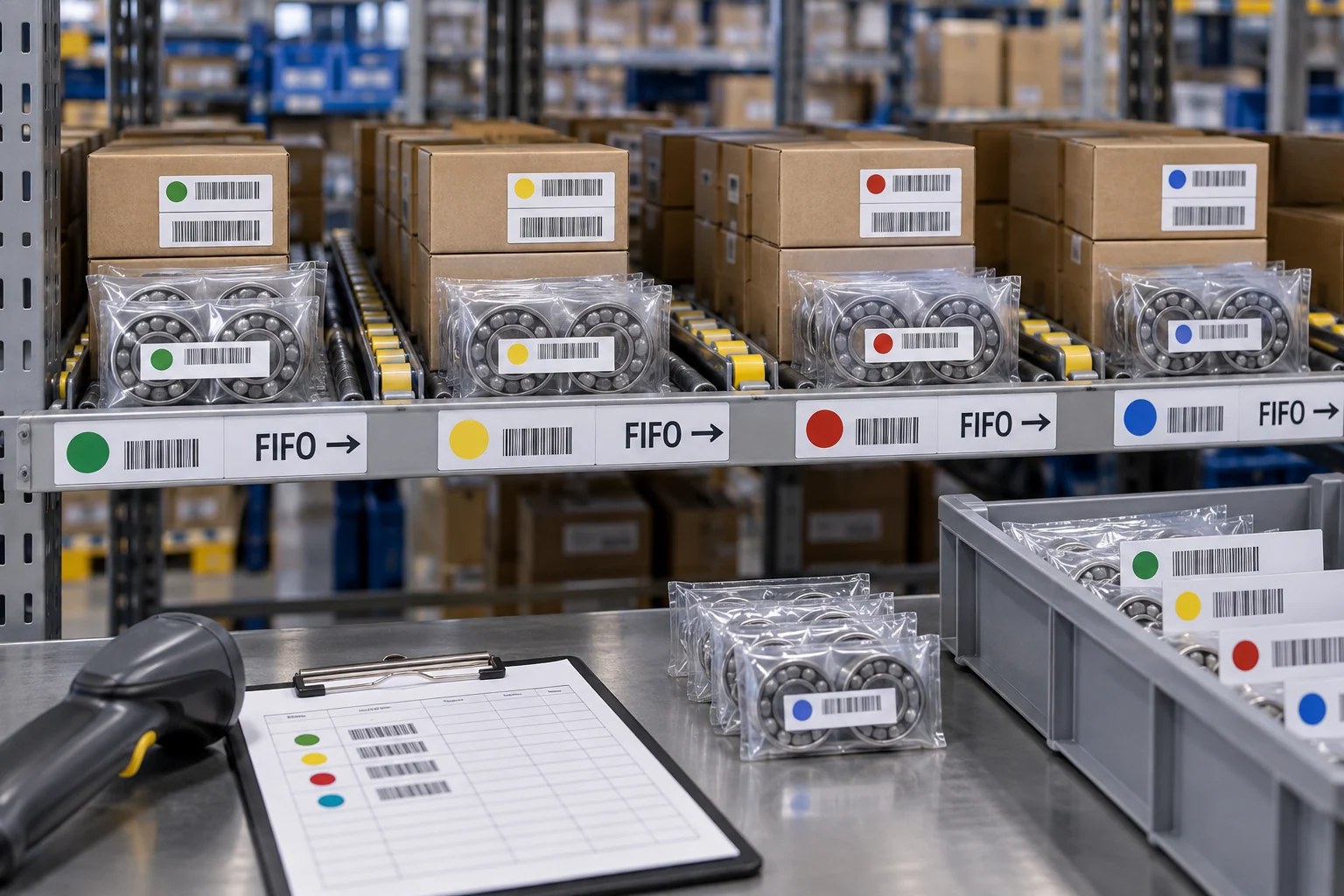
First-in/first-out is helpful only when dates and lots remain visible. The warehouse system should connect the supplier part number, customer part number, lot, receipt date, location, quantity, package status, and any inspection or environmental hold. If lots are split between locations, preserve the link rather than creating a new anonymous stock code.
Inventory rotation should not override a quality hold. Material affected by a leak, damaged packaging, lost identification, uncontrolled opening, or a documented environmental excursion must remain segregated until disposition. Likewise, an older lot should not be released simply to reduce inventory if its product-specific review conditions have not been met.
Define pre-installation release checks
The release process should be proportionate to product risk and storage history. Begin with documentation and package condition. Confirm part number, lot, quantity, label legibility, package integrity, and any applicable storage record. Look for evidence of moisture, staining, corrosion, contamination, damaged closures, displaced grease, or handling damage using a method that does not itself contaminate the product.
For noise-, torque-, or reliability-sensitive applications, engineering may require functional sampling or requalification after extended or questionable storage. Define the fixture, conditioning, sample quantity, measurements, acceptance limits, and treatment of opened samples. A casual hand-spin check is not equivalent to a controlled torque, noise, or vibration method.
Do not wash, relubricate, or repackage bearings as an informal recovery step. Those actions can alter the approved product condition and may require a controlled process, supplier agreement, and revalidation.
Treat sealed and open bearings deliberately
Sealed or shielded bearings
Record the closure type and lubricant requirement. Check that the package and closures are undamaged and that the product remains traceable. If storage duration or conditions raise concern, ask the supplier what inspection or requalification is appropriate for that specific construction. Do not assume that the closure proves the lubricant and internal condition are unchanged.
Open bearings
Protect open bearings from contamination and loss of the delivered preservation condition. Open packages only in the controlled area and sequence defined for inspection or assembly. Coordinate any cleaning, drying, lubrication, and handling requirements with the assembly process so that the warehouse does not unintentionally replace the supplier's condition with an unvalidated one.
The distinction is operational: each construction needs its own packaging, exposure, lubricant, and release controls. Neither “open” nor “sealed” is a complete storage specification.
Assign supplier and OEM responsibilities
The supplier should state the delivered construction, packaging and preservation method at the agreed level, traceability, and change-notification requirements. The OEM should control receipt, environment, location, stacking, package opening, inventory rotation, holds, release inspection, and assembly handoff.
The purchase specification should identify who decides the disposition after extended storage or an excursion. It should also define which changes—such as lubricant, rust preventative, inner packaging, sealing method, label, production site, or storage recommendation—require notification before implementation.
FAQ
What is the shelf life of a sealed bearing?
There is no universal number that applies to every sealed bearing. The construction, lubricant, packaging, storage conditions, traceability, and supplier guidance must be reviewed together.
Should bearings stay in their original packaging?
Normally, preserve the supplier's packaging until controlled inspection or use. If opening is required, document the reason and protect the remaining quantity with an approved method.
Can a bearing be released if the carton looks clean?
External appearance is only one check. Confirm the inner package, identification, lot linkage, storage history, and any product-specific inspection requirements.
Should older bearings be relubricated before use?
Not as an automatic warehouse action. Relubrication changes the controlled condition and may require a defined cleaning, lubricant, fill, inspection, and requalification process.
What should trigger supplier contact?
Triggers may include extended storage beyond the agreed review point, damaged or opened packaging, humidity or water exposure, lost traceability, corrosion indicators, lubricant concerns, or a change in the intended application.
Evidence record and engineering limits
- NTN Global — Bearing storage supports preserving rust prevention and secure packaging, controlling storage conditions and humidity, keeping packages off the ground, and avoiding excessive stacking. It does not establish a universal LUMI storage period.
- RBC Industrial — Bearing Storage and Shelf Life supports treating storage life as dependent on bearing type, lubricant, conditions, and inspection. Its numeric examples are not adopted here as LUMI rules.
Prepare a storage-control question for LUMI
For a product-specific review, share the bearing designation, closure, lubricant requirement, lot and date fields, supplier packaging, warehouse conditions, expected storage duration, opening and issue process, application sensitivity, and proposed release checks. Review the miniature bearing range, quality process, sample-to-production lot control guide, and manufacturing overview, then use the project inquiry form to define the storage and release boundary.